
A pumping schedule is mostly two numbers: how often and how long. Here is what Cleveland Clinic and Cambridge University Hospitals say, a sample day built from those numbers, and how to keep track of every session.
The short answer
Pump about every 3 hours, for about 20 minutes each time, which is 30 to 40 minutes with setup (Cleveland Clinic). If your baby is not latching yet and you are building your supply, Cambridge University Hospitals (NHS) says to pump 8 to 10 times in 24 hours, with at least one session between 1 and 5 AM. Ask your midwife, health visitor or paediatrician about your own plan.
How often to pump: about every 3 hours
Cleveland Clinic says to pump about every 3 hours. Over a full day and night, that is about 8 pumping sessions in 24 hours.
The number gives you a way to plan the day around pumping.
If you are breastfeeding as well, your pumping fits around the baby's feeds. Breastfed newborns feed 8 to 12 times in 24 hours (CDC, NHS), so feeds and pumping can fill most of the day. Our guide to how often a newborn feeds has those numbers.
How long a pumping session takes
Cleveland Clinic says each session is about 20 minutes of pumping. With setup, it is 30 to 40 minutes in all.
Setup is the part people forget. It covers getting the pump out, putting it together, sitting down, and cleaning up after. It adds 10 to 20 minutes to every session.
Over a day, that time adds up. Eight sessions of 30 to 40 minutes is between 4 hours and 5 hours 20 minutes a day. Knowing this helps you plan help from a partner or family.
Pumping when the baby is not latching yet
Some babies cannot feed at the breast at first. In that case, pumping is how you build your milk supply.
For this case, Cambridge University Hospitals (CUH), an NHS trust, gives a higher number. It says to pump 8 to 10 times in 24 hours, with at least one session between 1 and 5 AM.
This is more often than the every 3 hours rhythm above. Ten sessions in 24 hours works out to one about every 2 and a half hours, day and night. The night session is part of the advice, not an extra. Ask your midwife, health visitor or paediatrician to help you with a plan for your baby. They can also tell you when the plan can change.
A sample pumping schedule, every 3 hours
Here is one example of a day built from the Cleveland Clinic number. It is a starting point to adjust, not a medical plan.
| Session | Time |
|---|---|
| 1 | 6 AM |
| 2 | 9 AM |
| 3 | 12 noon |
| 4 | 3 PM |
| 5 | 6 PM |
| 6 | 9 PM |
| 7 | 12 midnight |
| 8 | 3 AM |
This gives 8 sessions in 24 hours. The 3 AM session falls inside the 1 to 5 AM window that CUH names for building supply. If you are aiming for 9 or 10 sessions, the gaps get shorter than 3 hours.
Pumping at work
The Cleveland Clinic advice also covers pumping at work. The same rule applies: about every 3 hours.
In an 8-hour workday, that means 2 or 3 sessions at work. With setup, each one takes 30 to 40 minutes. It helps to agree on the times and a quiet place before your first day back.
Keeping track of each pumping session
A schedule only helps if you know what really happened. When you are tired, sessions blur together. Did you pump at midnight, or was that yesterday?
For each session, it helps to write down:
- The time it started
- The side, or both
- How long it took
- How much milk you got, if you measure it
Over a week, this shows whether you are keeping to your schedule. It shows whether the night session happened. If you are building supply, it gives your midwife or health visitor real numbers to look at.
If someone else gives the baby a bottle of expressed milk, write that down as a feed too. Then you can see what was pumped and what was drunk.
Keep it in one place that every carer can reach. A notebook by the pump works until the other parent is the one doing the night bottle. A shared record means nobody has to ask.
How Veilleuse times each pumping session and adds up the milk
Veilleuse has a Pumping card on Home. It shows how long since the last session. Tap the + to add one: pick the side, start the optional timer, and add the amount in ml or oz if you measured it.
With Siri on iPhone, even with the phone locked, say "Pumping in Veilleuse". The pumping timer shows on the lock screen and in the Dynamic Island, with a Stop button on iOS 17 or later. You do not have to unlock the phone with pump parts in your hands.
On the Family plan, the week view shows pumped ml per day with a daily average. Ask "How much did I pump this week?" and the total is worked out from your own sessions.
On the Family plan, when a carer gives a bottle of expressed milk, they add it as a feed from their own account. You see it on the same day. Veilleuse does not give medical advice.
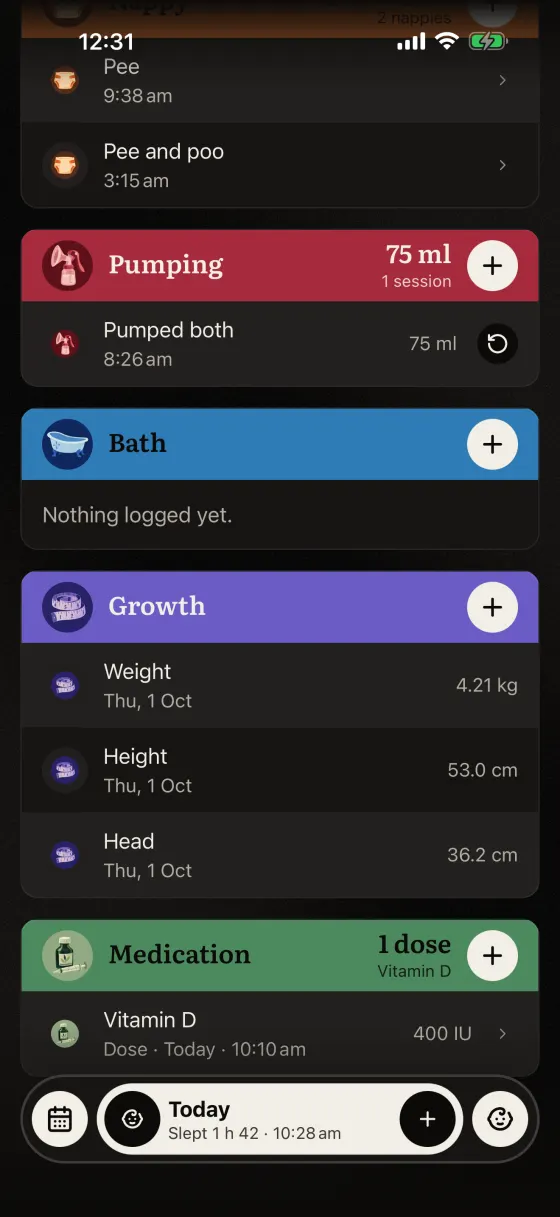
Pumping, baths, growth and medicine have their own cards.
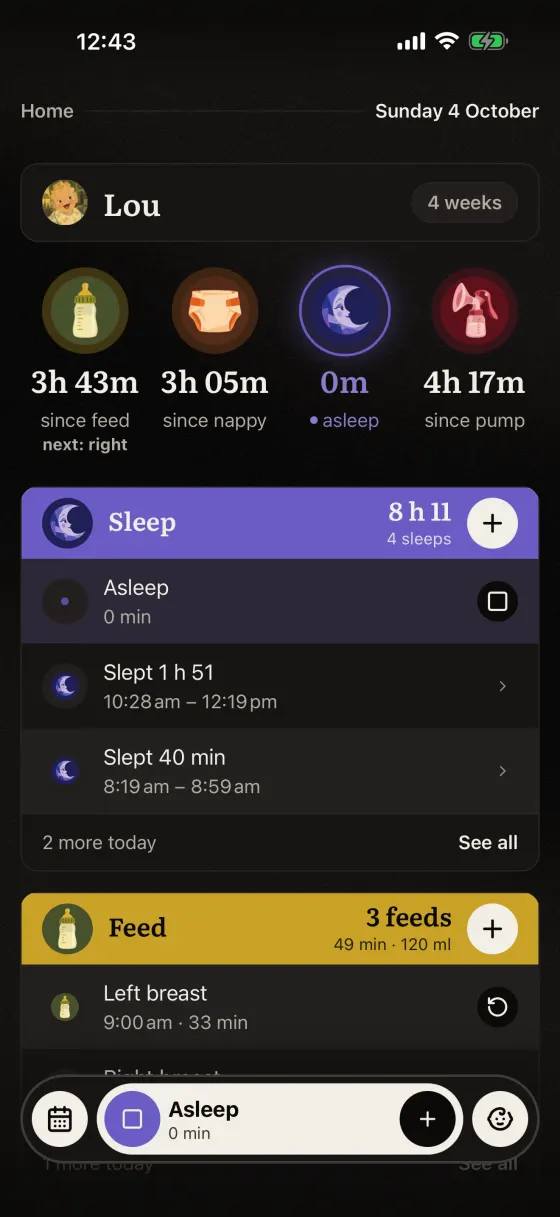
A sleep timer runs while she naps.
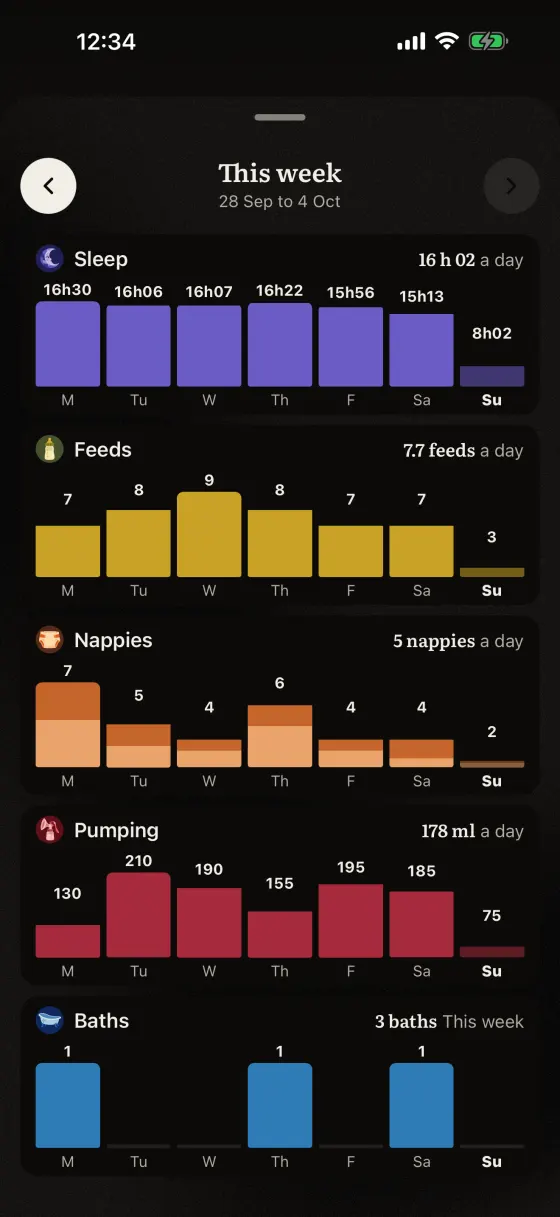
The week: sleep, feeds, nappies and pumping per day.
Questions parents ask
How often should I pump?
Cleveland Clinic says about every 3 hours. That is about 8 sessions in 24 hours.
How long should a pumping session last?
Cleveland Clinic says about 20 minutes of pumping, or 30 to 40 minutes including setup.
How many times a day should I pump if my baby is not latching?
Cambridge University Hospitals (NHS) says 8 to 10 times in 24 hours to build your supply, with at least one session between 1 and 5 AM. Ask your midwife, health visitor or paediatrician to help with your plan.
How much time does pumping take in a day?
At about 8 sessions of 30 to 40 minutes each, including setup, pumping takes between 4 hours and 5 hours 20 minutes a day. That is why it helps to share the other jobs.
Do I need to pump at night?
When you are building supply because the baby is not latching yet, CUH says at least one session should be between 1 and 5 AM. Ask your midwife or health visitor what fits your situation.
Can Veilleuse track how much milk I pump?
Yes. Each pumping session can have a side, a timer and an amount, and on the Family plan the week view shows pumped ml per day. Veilleuse is available now on iPhone. Logging one baby by hand is free. The Family plan is $11.99 a month, with your first month at half price, or $79.99 a year for the whole family.