
Newborns feed often, day and night. Here are the CDC, NHS, WHO and AAP numbers for breast and bottle feeds, the hunger cues that come before crying, and why midwives ask you to track feeds in the first weeks.
The short answer
Breastfed newborns feed 8 to 12 times in 24 hours, and in the first days that can mean every 1 to 3 hours (CDC, NHS). Formula-fed babies take up to 1 to 2 oz (30 to 60 ml) per feed in the first week, then 3 to 4 oz (90 to 120 ml) about every 3 to 4 hours by 1 month (AAP). Breastfeed on demand, day and night (WHO), and ask your midwife, health visitor or paediatrician if you are unsure.
How often a breastfed newborn feeds
Breastfed newborns feed 8 to 12 times in 24 hours. That number comes from the CDC and the NHS. In the first few days, it can mean a feed every 1 to 3 hours.
Over the first weeks, most exclusively breastfed babies feed every 2 to 4 hours. That is still a lot of feeds. It is also what the health services expect.
The gaps between feeds are not always even. Some feeds come close together. Others are further apart. The count over the whole 24 hours is what the numbers above describe.
Feed the baby on demand, day and night
The WHO says to feed on demand, day and night. In plain words, you follow your baby, not a clock.
Night feeds count too. The 8 to 12 feeds are spread over 24 hours, so several of them happen while it is dark.
Sleepy newborns may need waking for a feed
Some newborns sleep past the time they would usually feed. The CDC and the NHS both say sleepy newborns may need waking to feed.
If you are not sure whether to wake your baby, or how long to let them sleep, ask your midwife, health visitor or paediatrician. They know your baby's weight and how feeding is going.
How much formula a newborn needs by age
Bottle feeds of formula have amounts as well as times. The American Academy of Pediatrics (AAP) gives these numbers on its HealthyChildren site.
| Baby's age | Formula per feed | How often |
|---|---|---|
| First week | Up to 1 to 2 oz (30 to 60 ml) | Follow the baby's hunger cues |
| By 1 month | 3 to 4 oz (90 to 120 ml) | About every 3 to 4 hours |
| By 6 months | 6 to 8 oz (180 to 240 ml) | 4 to 5 feeds a day |
The AAP also gives a daily guide. A baby takes about 2.5 oz of formula per pound of body weight a day. The upper limit is about 32 oz (960 ml) a day.
These are guides from the AAP. If you have questions about your baby's amounts, your paediatrician or health visitor can help.
Hunger cues to look for before the baby cries
Babies show they are hungry before they cry. The AAP and the NHS list these early hunger cues:
- Restlessness
- Sucking on a fist
- Murmuring
- Rooting
Crying is a late hunger cue. If you can, offer a feed when you see the early signs.
Switching breasts during a breastfeed
When your baby finishes one breast, burp them and offer the other.
The AAP says you cannot overfeed a breastfed baby. Let the baby feed until they are full. That is one more reason the clock matters less than the baby.
Why midwives ask you to track feeds in the first weeks
The Children's Hospital of Philadelphia (CHOP) asks parents to record feeds, wet nappies and stools for the first few weeks. You keep going until the baby is back to birth weight and gaining.
Feeds and nappies go together. Nappies are one way to see that milk is going in. Our guide to wet and dirty nappies by day has the numbers.
What to write down for each feed:
- The time it started
- Breast (left, right or both) or bottle
- For a bottle, the amount, and whether it was formula or expressed milk
A paper diary works. So does a notes app. What matters is that the record is there when you are tired and someone asks "when did she last feed?". If the numbers worry you, show them to your midwife, health visitor or paediatrician.
If you pump as well as breastfeed, our pumping schedule guide covers how often and how long.
How Veilleuse shows the time since the baby's last feed
Veilleuse puts the time since the last feed at the top of Home. It also shows which side is next after a breastfeed. You no longer have to work it out at 3 AM.
Most feeds are added with the + on the Feed card. Pick a breastfeed (left, right or both, with an optional timer) or a bottle in ml or oz (formula, expressed milk or mixed). If you have several things to add, say them in one sentence, like "bottle of 90 ml at 2 and a wet nappy". Check the draft cards, then save.
With Siri on iPhone, even with the phone locked, say "Feeding on the left in Veilleuse", then "Done feeding in Veilleuse". The breastfeed timer shows on the lock screen. Ask "When was the last feed in Veilleuse?" and the answer comes from your own feeds.
On the Family plan, the week view shows feeds per day with a daily average, and each carer has their own account and sees the same day. Veilleuse does not give medical advice.
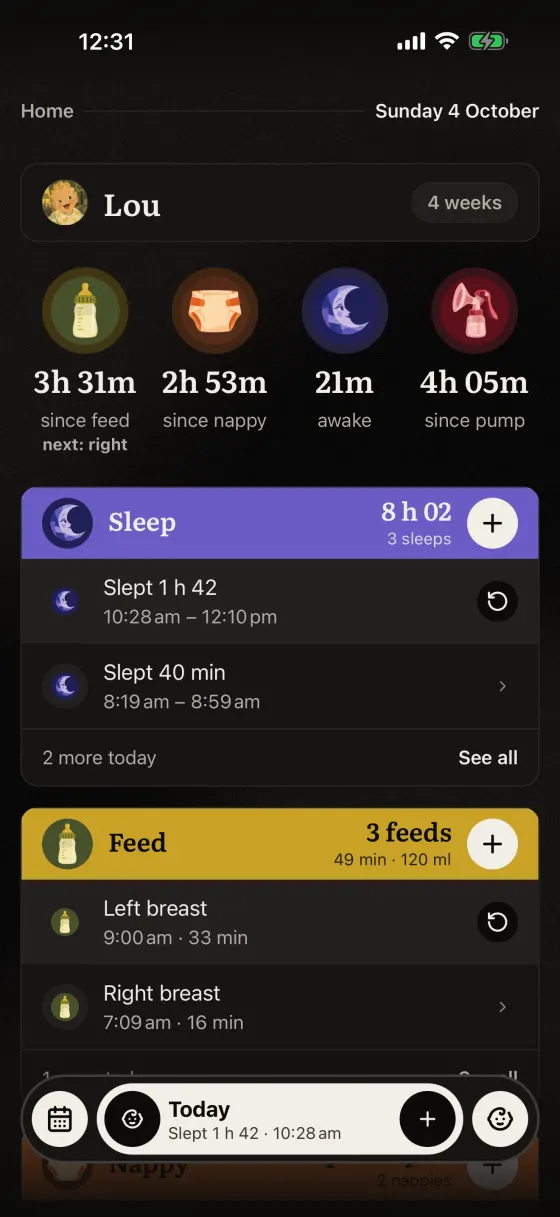
Home: how long since the last feed, nappy and sleep.
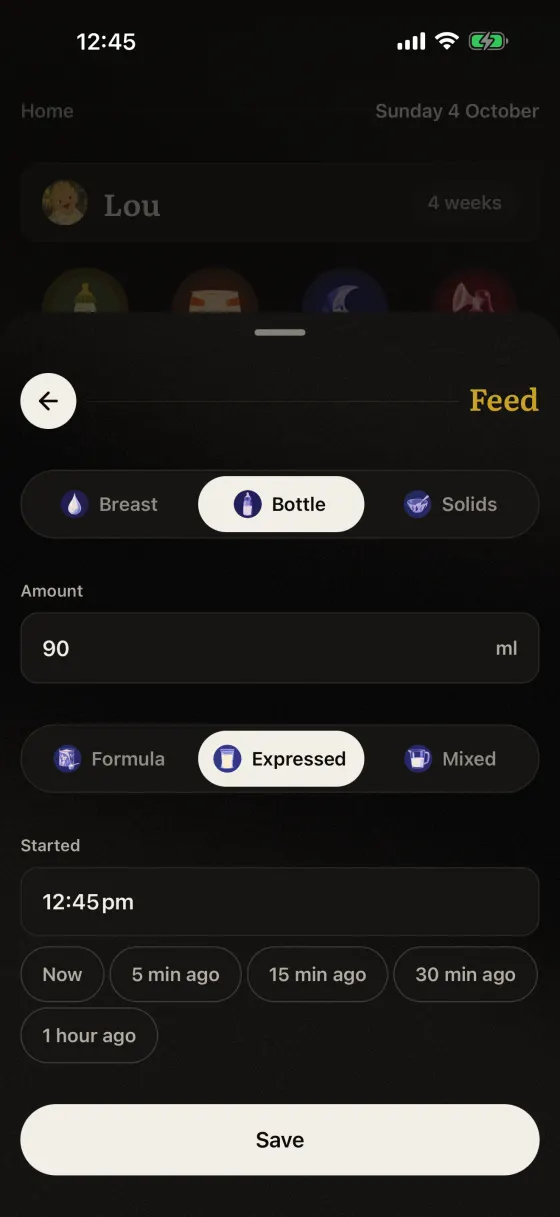
Or tap + and fill in a feed by hand.
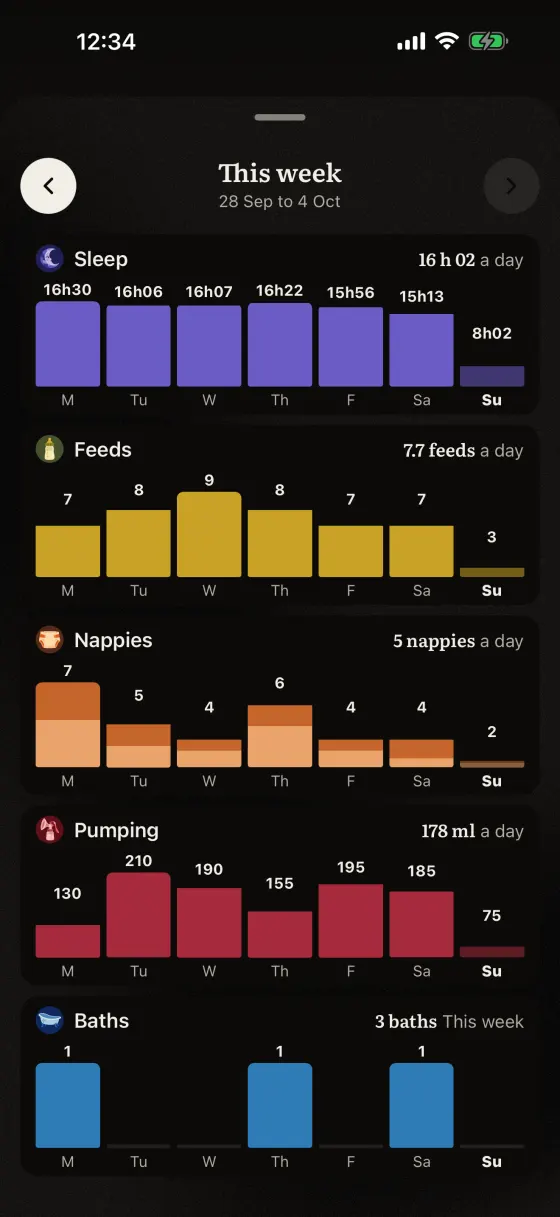
The week: sleep, feeds, nappies and pumping per day.
Questions parents ask
How often should a newborn breastfeed?
Breastfed newborns feed 8 to 12 times in 24 hours, according to the CDC and the NHS. In the first days that can be every 1 to 3 hours. Over the first weeks, most exclusively breastfed babies feed every 2 to 4 hours.
How much formula should a newborn drink?
The AAP says up to 1 to 2 oz (30 to 60 ml) per feed in the first week, and 3 to 4 oz (90 to 120 ml) about every 3 to 4 hours by 1 month. By 6 months it is 6 to 8 oz (180 to 240 ml), 4 to 5 feeds a day. The daily limit is about 32 oz (960 ml).
Should I wake my newborn to feed?
The CDC and the NHS say sleepy newborns may need waking to feed. Ask your midwife, health visitor or paediatrician what is right for your baby.
Can you overfeed a breastfed baby?
No. The AAP says you cannot overfeed a breastfed baby. Let the baby feed until full, and offer the other breast after a burp.
How do I keep track of my newborn's feeds?
CHOP asks parents to record feeds, wet nappies and stools for the first few weeks, until the baby is back to birth weight and gaining. Veilleuse shows how long it has been since the last feed, on Home and through Siri. Veilleuse is available now on iPhone. Logging one baby by hand is free. The Family plan is $11.99 a month, with your first month at half price, or $79.99 a year for the whole family.
Sources
- CDC: How much and how often to breastfeed
- NHS: Breastfeeding, the first few days
- WHO: Exclusive breastfeeding for six months best for babies everywhere
- HealthyChildren (AAP): Amount and schedule of formula feedings
- HealthyChildren (AAP): How often and how much should your baby eat?
- Just One Norfolk (NHS): Feeding cues
- CHOP: Breastfeeding diary