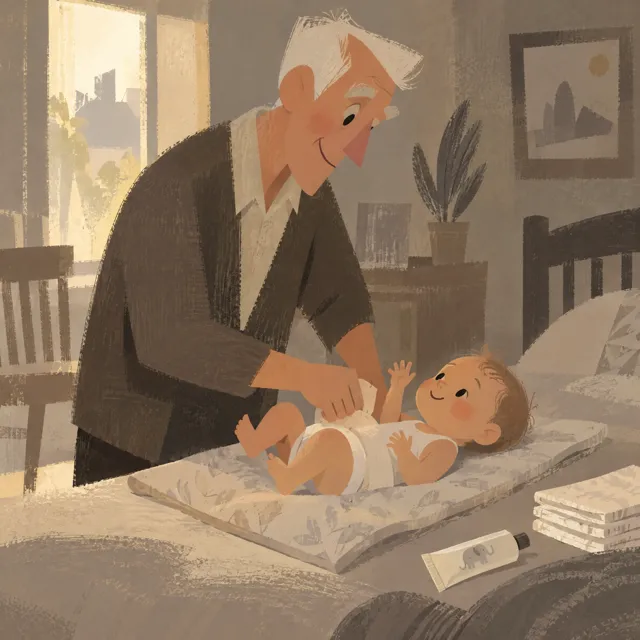
Nappies are one of the clearest signs your newborn is getting enough milk. Here are the NHS numbers for wet and dirty nappies day by day, what the AAP adds, and when to call your midwife.
The short answer
From day 7 to day 28, a newborn should have 6 or more heavy wet nappies and at least 2 yellow dirty nappies a day (Cambridge University Hospitals, NHS). The first days are lower: 1 to 2 wet on days 1 to 2, 3 or more on days 3 to 4, and 5 or more on days 5 to 6. If a breastfed baby has no poo for 24 hours, tell your midwife.
Why midwives ask about the baby's nappies
Midwives ask about wet nappies (diapers) and dirty ones for a simple reason. What comes out shows that milk is going in.
Cambridge University Hospitals, an NHS trust, lists nappies among the signs a baby is getting enough milk. The AAP does the same. The Children's Hospital of Philadelphia (CHOP) asks parents to record feeds, wet nappies and stools for the first few weeks, until the baby is back to birth weight and gaining.
So the numbers below are worth knowing. They change quickly in the first week.
Wet and dirty nappies by day: the NHS numbers
These numbers come from Cambridge University Hospitals (CUH). They count nappies in 24 hours.
| Baby's age | Wet nappies in 24 hours | Dirty nappies in 24 hours |
|---|---|---|
| Days 1 to 2 | 1 to 2 | At least 1 (meconium) |
| Days 3 to 4 | 3 or more | At least 2 |
| Days 5 to 6 | 5 or more | At least 2 |
| Day 7 to 28 | 6 or more, heavy | At least 2, yellow, the size of a £2 coin |
Two things stand out. The number of wet nappies climbs every couple of days in the first week. Then, from day 7, the wet nappies should be heavy, not just damp.
Meconium is the baby's first poo, in the first days. By the end of the first week, CUH expects dirty nappies to be yellow and about the size of a £2 coin.
From day 7: 6 heavy wet nappies a day
From day 7 to day 28, CUH expects 6 or more heavy wet nappies every 24 hours. It also expects at least 2 yellow dirty nappies.
This is the number most parents end up checking. It holds for the rest of the first month. A count over each 24 hours is enough to see it.
What the AAP says about nappies and weight
The American Academy of Pediatrics (AAP) gives similar numbers. By days 5 to 7, it expects 6 or more wet nappies and 3 to 4 yellow stools a day.
The AAP's count of dirty nappies is a little higher than the CUH one. The two sources agree on the wet nappies: around 6 by the end of the first week.
The AAP also gives a number for weight. Babies should lose no more than 8 to 10% of birth weight. Your midwife, health visitor or paediatrician weighs the baby to check this. Nappies help you between those checks.
When to call the midwife about the baby's nappies
CUH gives one clear signal. If a breastfed baby has no poo for 24 hours, tell the midwife.
For anything else, use the numbers above as your guide. If your baby has fewer nappies than the table shows, or something looks different and you are worried, ask your midwife, health visitor or paediatrician. You do not need to be sure something is wrong before you ask.
How to count wet and dirty nappies when you are tired
Counting nappies sounds easy. At 3 AM, after the fourth change of the night, it is not. Here is what helps:
- Write each nappy down when you change it, not later.
- Note whether it was wet, dirty or both. A nappy that is both counts as one wet and one dirty.
- Count in 24 hours, the way the table does.
- Make sure every carer writes nappies in the same place.
The last point matters most when two people share the nights. If each parent keeps their own count, nobody has the full day. A shared record solves it.
Feeds and nappies are worth tracking together. Our guide to how often a newborn feeds has the feeding numbers, and the newborn sleep guide covers sleep by age.
How Veilleuse counts the baby's wet and dirty nappies
Veilleuse keeps the count for you. Tap the + on the Nappy card and pick wet, dirty, both or dry. Home shows how long since the last nappy.
On the Family plan, if you change a nappy during a feed, you can say both in one sentence, like "bottle of 90 ml at 2 and a wet nappy at 3". Veilleuse shows draft cards. Check them, then save.
With Siri on iPhone, even with the phone locked, say "Wet nappy in Veilleuse" or "Poo in Veilleuse". Ask "Last poo in Veilleuse?" to see when the last dirty nappy was.
On the Family plan, the week view shows nappies per day, split into wet and dirty, with a daily average. You can hold that up against the CUH table. Ask "How many nappies in the last 24 hours?" and the answer is counted from your own nappies.
On the Family plan, each carer has their own account, so every change counts, and nappy reminders go to every phone. Veilleuse does not give medical advice.
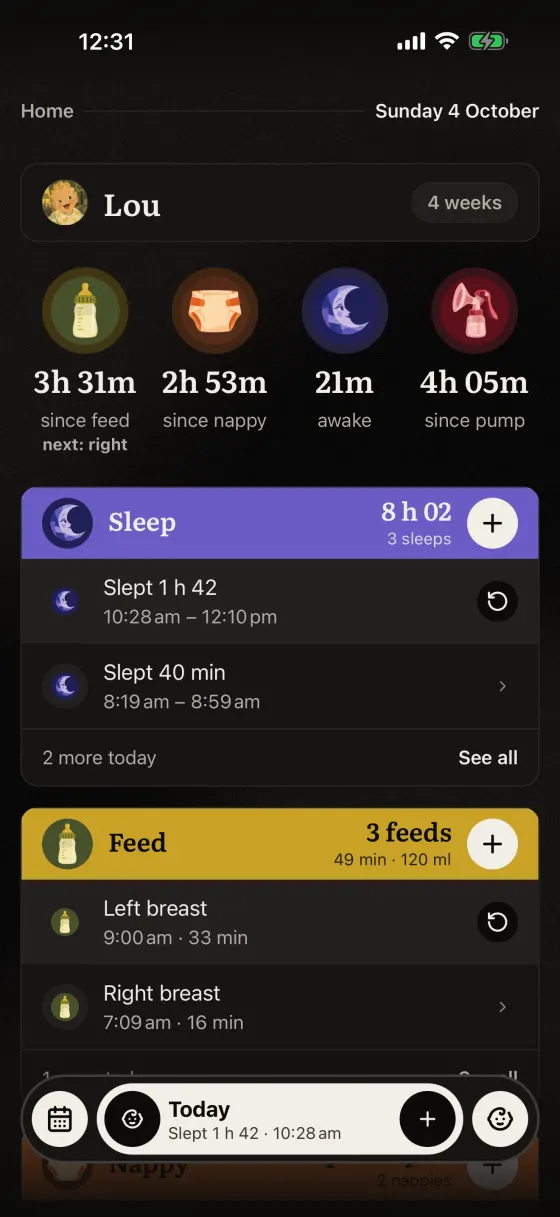
Home: how long since the last feed, nappy and sleep.
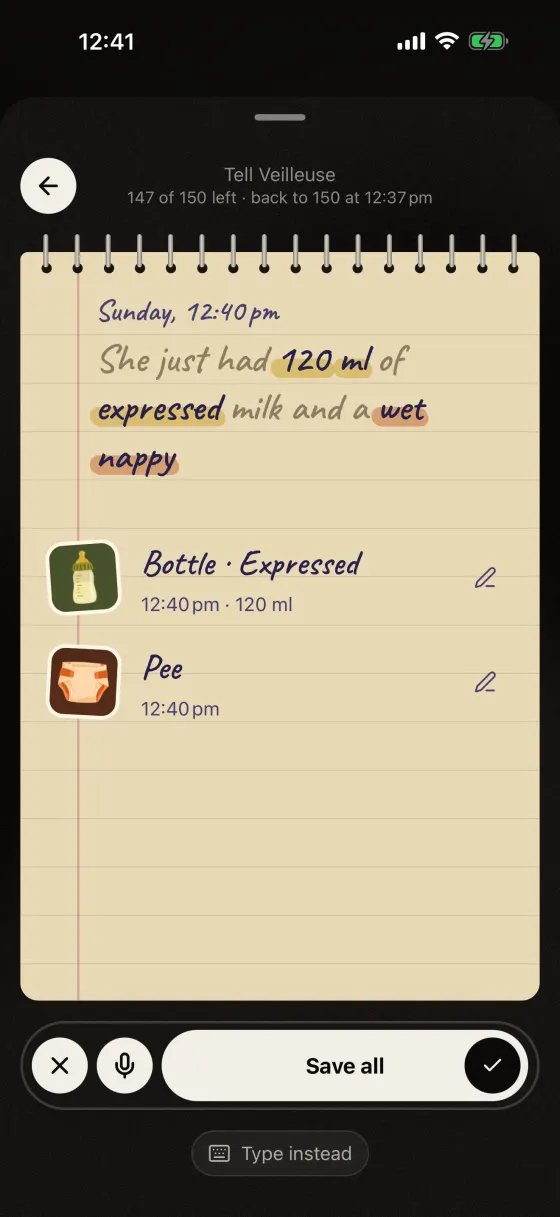
Say it in one sentence. Check the entries, then save.
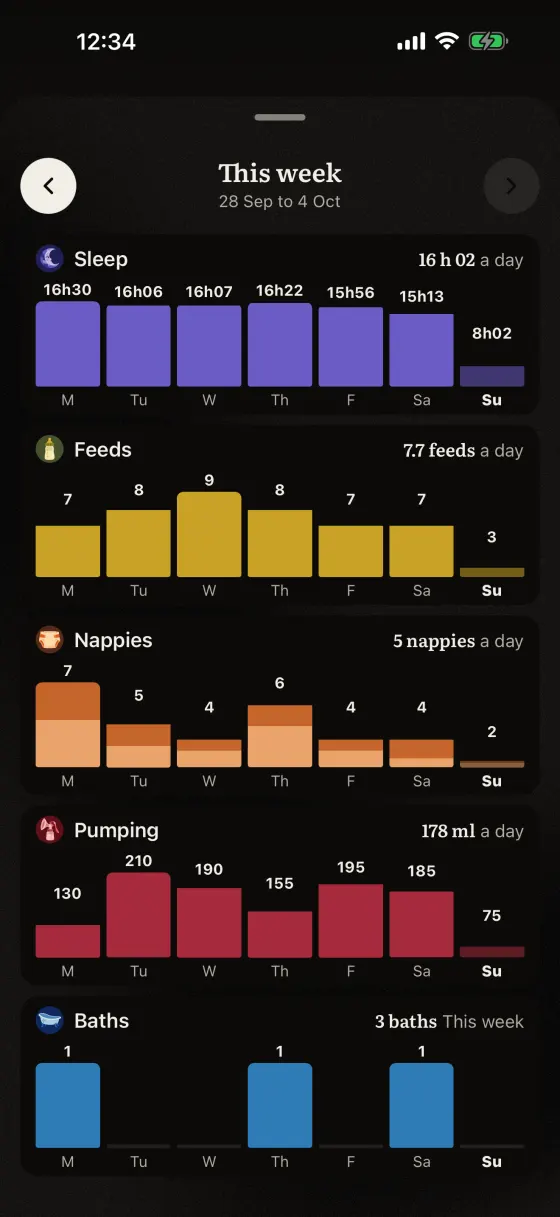
The week: sleep, feeds, nappies and pumping per day.
Questions parents ask
How many wet nappies should a newborn have?
Cambridge University Hospitals (NHS) gives 1 to 2 wet nappies on days 1 to 2, 3 or more on days 3 to 4, 5 or more on days 5 to 6, and 6 or more heavy wet nappies from day 7 to day 28.
How many dirty nappies is normal for a newborn?
CUH says at least 1 (meconium) on days 1 to 2, then at least 2 a day. From day 7, they should be yellow and about the size of a £2 coin. The AAP gives 3 to 4 yellow stools a day by days 5 to 7.
My breastfed baby has not pooed for 24 hours. What should I do?
CUH says to tell your midwife if a breastfed baby has no poo for 24 hours.
How much weight is it normal for a newborn to lose?
The AAP says babies should lose no more than 8 to 10% of their birth weight. Your midwife, health visitor or paediatrician checks this when they weigh your baby.
Can Veilleuse count wet and dirty nappies separately?
Yes. Each nappy is wet, dirty, both or dry, and on the Family plan the week view splits wet and dirty per day. Veilleuse is available now on iPhone. Logging one baby by hand is free. The Family plan is $11.99 a month, with your first month at half price, or $79.99 a year for the whole family.